Updated October 2026 · status checked Oct 10, 2026.
Status in 2026
Arcam lists the rHead as discontinued on its own site. It was announced around 2016 at about £400 in the UK, and today it shows up only on the used market (eBay, Head-Fi classifieds, used hi-fi dealers).
If you landed here ready to buy, there are two questions: does a used rHead fit your headphones, and is there a better new amp for similar money? Often the answer to the second is yes.
Buy Instead
Three gain settings including -10 dB for sensitive IEMs, and 415 mW into 300Ω for Sennheisers. $119 new with warranty.
The other clean budget desktop amp, about 2.6 W into 32Ω, sold direct by JDS Labs for about $129.
If you liked the idea of a Class A-style desktop amp and want to spend more: Schiit's $399 Asgard X.
| Arcam rHead (discontinued) | Magni (Unity) | JDS Atom Amp 2 | |
|---|---|---|---|
| Status | Discontinued | Current | Current |
| Price (Oct 2026) | Used only | $119 | ~$129 |
| Power, 32Ω | 1.1 W (rated) | 2.5 W (rated) | ~2.6 W |
| Power, 300Ω | 130 mW (rated) | 415 mW (rated) | n/a |
| Gain settings | None | 3 (incl. -10 dB) | See JDS Labs |
| Inputs | RCA + XLR | Single-ended | Single-ended |
Who a used rHead still suits: IEM and low-impedance headphone owners who want a balanced XLR input from a studio interface or DAC, and who find one at a clear discount to a new Magni.
Who should skip it: owners of 250–300Ω headphones, and anyone who wants a warranty.
Buying a Used rHead
- Turn the volume through its whole range and listen for scratchiness or one channel dropping out.
- Make sure the original power supply is included, or confirm a replacement matches its voltage, polarity and rating.
- Test both headphone outputs (3.5 mm and 6.35 mm) and both inputs (RCA and XLR).
- Expect warmth. Class A designs run warm. That’s normal.
The Original Review
What Made It Different: Discrete Class A
Most budget desktop amps (Magni, Atom, FiiO’s K-series) use op-amp-based Class AB designs, and the good ones are excellent. The rHead used a discrete Class A output stage. In Class A the output transistors conduct through the whole waveform, so there’s no crossover distortion to correct in the first place. The cost is heat and efficiency.
Power: Know What You’re Buying
Arcam’s published ratings:
- 2.0 W into 16Ω, 1.1 W into 32Ω. Plenty for IEMs, portable headphones and studio cans like the ATH-M50x or the DT 770 Pro 80Ω .
- 0.13 W (130 mW) into 300Ω. That’s about 6.2 V RMS. An HD 600 (97 dB/V) would reach roughly 113 dB, which is loud, but with less reserve than amps built for high-impedance headphones. A Magni (Unity) gives about 11 V into 300Ω.
The rHead’s power budget suits low-impedance and portable headphones. Match it accordingly.
Build and Connections
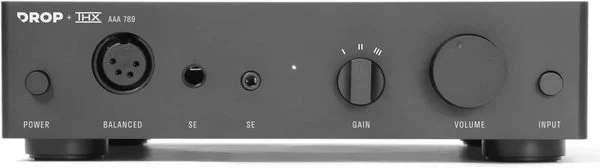
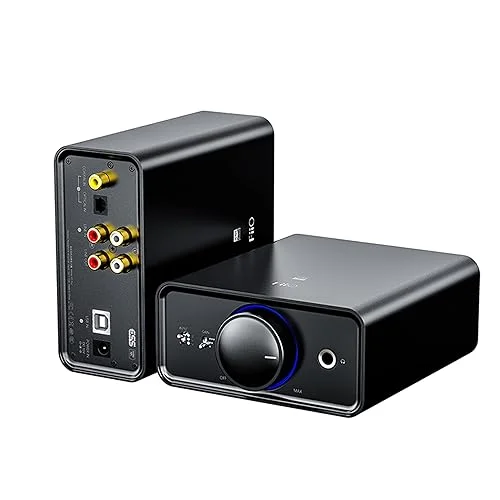
The rHead is a compact metal box with a single volume knob on the front and both 3.5 mm and 6.35 mm headphone outputs. The back has RCA and balanced XLR inputs, which made it an easy drop-in behind a studio interface or a balanced DAC. There’s no gain switch, no DAC and no display.
The Sound, by Reviewer Consensus
Reviews from the time described the rHead as neutral and composed, not the warm “Class A sound” some buyers expect. With sensitive IEMs, a low-noise, low-output-impedance amp keeps multi-driver sets tonally correct, which is where the rHead was strongest.
Verdict
The rHead is a nicely engineered amp for IEMs and low-impedance headphones, and a used one can still make sense. It’s discontinued, though, and a new Magni (Unity) at $119 covers more headphones with a warranty. If you run 300Ω Sennheisers, see our HD 600 amp guide instead. For IEMs on the go, our portable amp guide has current picks.