Updated October 2026 · price checked Oct 10, 2026.
Quick Answer
The K7 is no longer on FiiO’s website, but it’s still sold for about $220 (Oct 2026). It’s one of the most powerful one-box DAC/amps near that price, which makes it a good buy for planar headphones and 300Ω Sennheisers. For easier headphones, the newer and cheaper K11 R2R is the better choice.
Buy it for the power: 2 W into 32Ω and 560 mW into 300Ω from the 4.4 mm balanced output.
FiiO's newer, cheaper desktop DAC/amp with an R2R DAC. Enough for most headphones that aren't power-hungry.
The step up within FiiO's current line, about $319, if you want a newer R2R desktop unit with more headroom than the K11.
| FiiO K7 | FiiO K11 R2R | FiiO K13 R2R | |
|---|---|---|---|
| Status | Off fiio.com, still sold | Current | Current |
| Price (Oct 2026) | ~$220 | ~$170 | ~$319 |
| DAC | Dual AK4493SEQ | R2R | R2R |
| Power, 32Ω (rated) | 2 W bal / ~1.2 W SE | ~1.3 W bal / ~0.5 W SE | See FiiO |
| Power, 300Ω (rated) | 560 mW bal | ~220–250 mW bal | See FiiO |
| Balanced out | 4.4 mm | 4.4 mm | Yes |
Who should NOT buy the K7: IEM-only listeners (a dongle is enough), anyone who wants Bluetooth on their desk unit, and anyone with easy 32–80Ω headphones who’d save $50 with the K11 R2R.
Build and Connections
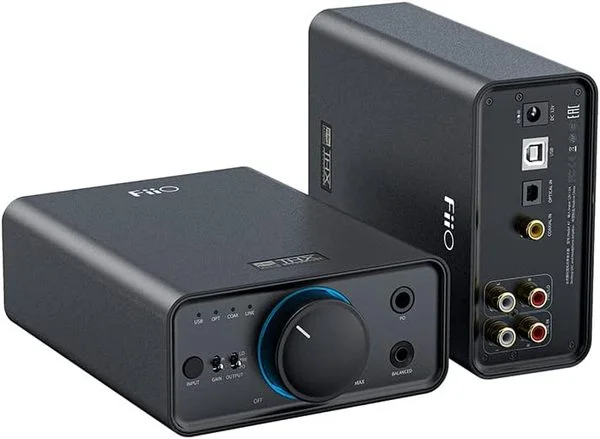
The K7 is a full-width aluminium box. The front has the volume knob and both headphone outputs: 6.35 mm single-ended and 4.4 mm balanced. The back has USB-B, optical and coaxial inputs, an RCA line input and an RCA output.
That RCA output has two modes in FiiO’s documentation: LO (fixed level, for a separate amp) and PRE (variable, for powered speakers). So the K7 can sit between a computer, a TV and a pair of active monitors.
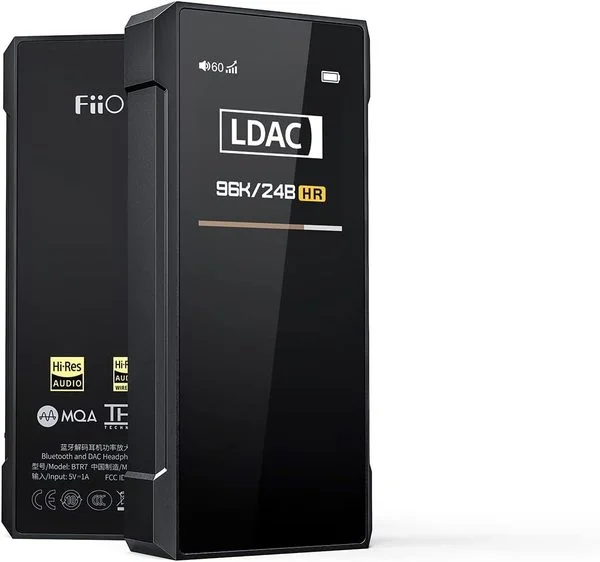
The standard K7 has no Bluetooth. FiiO sold a K7BT variant with a Bluetooth antenna. If you want wireless, make sure the listing says K7BT.
DAC Section
The K7 uses two AKM AK4493SEQ DAC chips. AKM chips have a reputation among owners for a slightly smoother, less forward presentation than ESS chips. Measured performance is well below audibility on both, so treat the “character” talk as preference, not a measured difference.
Amplifier Section: The Reason to Buy It
The K7 uses two THX AAA 788+ amp modules, the same family as FiiO’s pricier K9 Pro. FiiO’s published ratings:
- Balanced (4.4 mm): 2,000 mW into 32Ω, 560 mW into 300Ω
- Single-ended (6.35 mm): about 1,220 mW into 32Ω
In practical terms, 560 mW into 300Ω is about 13 V RMS. An HD 600 at 97 dB/V would reach well past safe listening levels with a lot of reserve. For planars like the HE400SE and Sundara, 2 W into 32Ω is plenty of current.
THX’s feed-forward amp design is known for low distortion and noise, and owners consistently describe the K7 as clean and neutral.
Pair It With
The K7 is a strong match for headphones that need power:
- Sennheiser HD 600 / HD 650: see the HD 600 amp guide and HD 650 amp guide .
- HiFiMAN HE400SE / Sundara: see the HE400SE amp guide and Sundara amp guide .
- Beyerdynamic DT 990 Pro / DT 1990 Pro: see the DT 990 Pro amp guide and DT 1990 Pro amp guide .
How It Compares
- vs Magni (Unity) + a DAC: Schiit’s $199 Magni with DAC card is single-ended only. The K7 adds balanced output and more inputs. See FiiO K7 vs Schiit Magni Heresy .
- vs Topping DX3 Pro+: the DX3 Pro+ has LDAC and a remote but much less power, and retailers now list it as discontinued. See DX3 Pro+ vs FiiO K7 .
- vs Topping DX5 II (~$299): more power, Bluetooth and a newer design for about $80 more.
Verdict
At about $220, the K7 is still worth buying for one reason: power. If your headphones need it, the K7 drives them better than anything else near its price. If they don’t, buy the K11 R2R and keep the difference. For a wider shortlist, see our best DAC/amp combos under $300 .