Updated October 2026 · status and prices checked Oct 10, 2026.
Status in 2026
JDS Labs replaced the Atom Amp+ with the Atom Amp 2 in late 2023. The Amp 2 costs about $129 (the Amp+ was about $99 in 2021) and, according to published reviews, delivers about 2.6 W into 32Ω against the Amp+’s roughly 1 W. It also moved to an all-metal chassis.
If you came here to buy an Atom Amp+, buy the Amp 2 instead. The original review is below because most of it still describes what the Atom line does well.
Buy Instead
The direct successor: about 2.6 W into 32Ω, all-metal case, about $129 direct from JDS Labs.
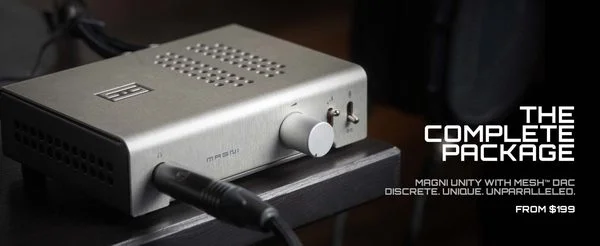
The other budget benchmark: rated at 2.5 W into 32Ω and 415 mW into 300Ω, with a -10 dB gain setting for IEMs. $119.
If you don't own a DAC: DAC and amp in one box with a 4.4 mm balanced output, about $170.
| Atom Amp+ (superseded) | Atom Amp 2 | Magni (Unity) | FiiO K11 R2R | |
|---|---|---|---|---|
| Status | Superseded | Current | Current | Current |
| Price (Oct 2026) | Used / leftover stock | ~$129 | $119 ($199 with DAC) | ~$170 |
| Power, 32Ω | ~1 W | ~2.6 W | 2.5 W (rated) | ~1.3 W balanced |
| DAC built in | No | No | Optional card | Yes |
| Where to buy | Used market | JDS Labs direct | Schiit direct | Retail |
Who should still buy a used Amp+: someone with dynamic headphones (HD 600, DT 770, DT 990) who finds one well below the Amp 2’s price.
Who should skip it: planar owners who want headroom, and anyone who’d rather have the warranty. The Amp 2’s extra power is the main reason to pay more.
The Original Review
Why a $99 Amp Became the Benchmark
When Audio Science Review measured the original JDS Labs Atom, its results were competitive with amps costing many times more. The Atom Amp+ refined that design. Within the measurement-focused community it became the default “buy this and stop worrying” budget amp, because its noise and distortion were far below audibility.
Design
The Atom Amp+ is a small black box with a volume knob and a 6.35 mm output on the front, and RCA inputs plus a gain switch on the back. No display, no remote, no app. It’s built for a desk, not a showroom.
Power
At about 1 W into 32Ω, the Amp+ has more than enough for every common dynamic headphone, including 250Ω Beyerdynamics and 300Ω Sennheisers, and enough for mainstream planars like the HE400SE and Sundara at normal levels. It runs out of headroom with very inefficient planars such as the HE6se. That’s the gap the Atom Amp 2’s extra power closes.
Pairing Notes (Still Valid for the Atom Amp 2)
- Sennheiser HD 600 / HD 650: clean and plenty loud. See the HD 600 amp guide .
- Beyerdynamic DT 770 / DT 990 Pro: a transparent amp won’t add to the DT 990’s treble, but it won’t soften it either. See the DT 990 Pro amp guide .
- HiFiMAN HE400SE / Sundara: fine at normal levels; the Amp 2 adds useful headroom. See the HE400SE amp guide .
DAC Pairings
Any clean DAC with RCA outputs works. Common choices are the Topping E30 II , the SMSL SU-1 , JDS Labs’ own Atom DAC 2, or the Schiit Modi 5 ($149).
Verdict
The Atom Amp+ earned its reputation as the rational first amp: clean, compact and cheap. It’s been replaced by the Atom Amp 2, which keeps the formula and adds a lot more power for $30 more. Buy the Amp 2. For a side-by-side of the two budget benchmarks, see Magni Heresy vs Atom Amp+ , and for more options our best headphone amps under $200 .