Updated October 2026 · prices checked Oct 10, 2026.
Short answer: neither is better in general. Solid state measures cleaner and works with any headphone. An OTL tube amp adds warmth that many owners like on 300Ω Sennheisers, but its high output impedance makes it a poor match for planars and low-impedance headphones.
The Core Difference
Solid state amplifiers use transistors (MOSFETs, BJTs) to amplify the audio signal. Vacuum tube amplifiers use electron tubes (triodes, pentodes) to do the same job. Both achieve signal amplification; they do it through fundamentally different physics, which produces different distortion characteristics and different sounds.
Solid state: Low distortion, low noise, wide bandwidth, reliable, no maintenance. Measures better on nearly every objective benchmark.
Tube: Higher distortion, higher noise, requires periodic tube replacement, warm-up time needed, sounds different (subjectively preferred by many listeners on certain headphones).
How Tube Amps Add Character
The distortion that tube amplifiers add is predominantly even-order harmonic (2nd, 4th harmonics). These frequencies are musically related to the original signal — they’re the same note an octave higher. Many listeners perceive even-order distortion as “warmth” or “fullness.”
Solid state amps at clipping (overload) tend to produce odd-order harmonics (3rd, 5th) which are dissonant and sound harsh. Well-designed solid state amps avoid this entirely at normal listening levels.
This is why the tube/solid state debate is partially about distortion flavor rather than quantity: a tube amp at 1% distortion may sound more pleasant than a solid state amp at 0.1% distortion to some listeners, because the harmonic character differs.
OTL Tube Amps and High-Impedance Headphones
The most common headphone tube amplifiers are OTL (output transformer-less) designs. OTL amps work best with high-impedance loads (150–600Ω). The Sennheiser HD 600, HD 650, HD 6XX, HD 58X, and Beyerdynamic T1 all pair exceptionally well with OTL tube amps.
Schiit Valhalla 3 ($499, schiit.com): a current pre-built OTL amp. Schiit rates it at 250 mW into 300Ω, with output impedance of 25Ω (low gain), 40Ω (high gain) or 60Ω (no-feedback mode), and says outright that very low-efficiency headphones are out. See today's price for the Schiit Valhalla 3 from Schiit ↗
Bottlehead Crack (kit): the best-known DIY OTL headphone amp. HD 650 and HD 6XX owners on Head-Fi have recommended it for years. Building it takes patience and soldering; check Bottlehead for current pricing.
Darkvoice 336SE: a pre-built OTL amp sold through marketplaces, popular with HD 6XX owners on a budget. I couldn’t confirm a current US price.
Why OTL doesn’t work with low-impedance headphones: OTL amps have relatively high output impedance (25–60Ω on the Valhalla 3, for example). Low-impedance headphones (16–50Ω) are significantly affected by this — their frequency response changes based on the interaction between headphone impedance and amp output impedance. This causes audible bass and treble shifts that are generally undesirable.
Output impedance: the number that decides it
The usual rule is that an amp’s output impedance should be under 1/8 of the headphone’s impedance, or the headphone’s tuning shifts with its impedance curve.
| Amp (Oct 2026) | Type | Output impedance (maker spec) | Headphones that stay within the 1/8 rule |
|---|---|---|---|
| Schiit Valhalla 3 | OTL tube | 25Ω low gain / 40Ω high / 60Ω no-feedback | 200Ω and up on low gain (HD 600/650, 250Ω Beyers) |
| Schiit Vali 3 | Tube hybrid | 0.5Ω low gain / 1.8Ω high | Almost everything, including planars |
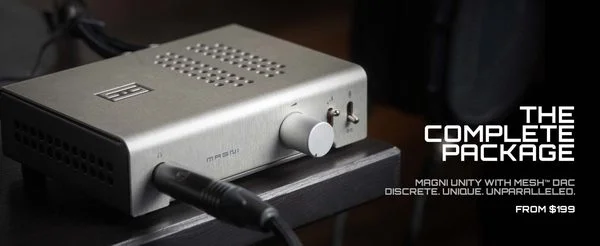
| Schiit Magni (Unity) | Solid state | under 0.1Ω | Everything, including IEMs |
Which type for which headphone
| Headphone | Recommended type | Why |
|---|---|---|
| Sennheiser HD 650 / HD 6XX (300Ω) | Either; OTL tube is popular | High impedance tolerates OTL; many owners like the added warmth |
| Sennheiser HD 600 (300Ω) | Either | Tube adds warmth; solid state stays neutral |
| Beyerdynamic DT 990 Pro (250Ω) | Either, solid state for neutrality | OTL on low gain stays within the rule; tube warmth is a matter of taste |
| HiFiMAN HE400SE (25Ω) | Solid state or hybrid | Needs ~80 mW of current; OTL output impedance is far too high |
| HiFiMAN Sundara (37Ω) | Solid state or hybrid | Same reason. See the Sundara pairing guide |
| Beyerdynamic DT 1990 Pro (250Ω) | Solid state or hybrid | See the DT 1990 Pro pairing guide |
Practical Considerations
Cost: a good solid-state amp like the Schiit Magni (Unity) costs $119. Schiit’s tube options are the Vali 3 hybrid at $149 and the Valhalla 3 OTL at $499 (schiit.com, Oct 2026). Tubes also need occasional replacement.
Warm-up time: tubes need some minutes to reach operating temperature, and many owners wait longer before critical listening. Solid state is ready almost instantly.
Noise: Tube amps have a slightly higher noise floor. With sensitive headphones (IEMs, ATH-M50x), this noise can be audible as a hiss. Solid state amps are quieter, making them better for sensitive headphones.
Reliability: Solid state amplifiers can last 20+ years without maintenance. Tube amplifiers require periodic tube replacement and are more sensitive to vibration and heat.
The Bottom Line
Buy solid state if:
- Your headphones are below 100Ω (planars, ATH-M50x, DT 770/990 80Ω)
- You want a maintenance-free setup
- You use sensitive headphones (IEMs) where noise floor matters
- You prefer the most accurate, uncolored reproduction
Buy a tube amp if:
- You own a 300Ω Sennheiser: HD 6XX, HD 650 or HD 600
- You listen to jazz, classical, or vocal music where warmth and midrange texture are priorities
- You enjoy the ritual of tubes and are willing to maintain them
- You’ve already heard solid state and want to explore the difference
What to buy (October 2026)
Current OTL tube amp for 300Ω Sennheisers and 250Ω Beyers: 250 mW into 300Ω, 25Ω output impedance on low gain. Not for planars.
The solid-state default: under 0.1Ω output impedance and 415 mW into 300Ω for $119. Works with every headphone, including IEMs.
Want a taste of tubes without the OTL limits? The Schiit Vali 3 tube hybrid ($149 at schiit.com ) is rated 1.5 W into 32Ω and 400 mW into 300Ω with 0.5–1.8Ω output impedance, so it also works with planars.
More: best amp for HD 650 · best amp for HD 600 · best headphone amps under $300