Updated October 2026 · prices checked Oct 10, 2026.
Short answer: headphone impedance (in ohms, Ω) tells you how much voltage a headphone needs relative to the current it draws. Higher impedance means it needs more voltage to get loud, but you need the sensitivity rating as well to know whether a phone can drive it.
What Impedance Means
Impedance (measured in ohms, Ω) is the total resistance a headphone presents to the electrical signal from your amplifier or device. It’s the combination of the DC resistance of the voice coil and the reactive impedance created by the driver’s inductance and compliance.
In practical terms: high impedance means the headphone is harder to push to volume, and the signal source needs more voltage to drive it.
The Basic Rule
| Impedance | Typical Use | Requires |
|---|---|---|
| 16–32Ω | IEMs, portable headphones | Phone, any source |
| 38–80Ω | Portable cans, studio monitors | Phone or weak amp |
| 150–250Ω | Professional monitors, reference headphones | Dedicated amp recommended |
| 300–600Ω | High-end reference headphones | Dedicated amp required |
Why Impedance Matters: Efficiency vs. Control
Low-impedance headphones (16–80Ω) get loud easily from weak sources. A phone producing 0.5V of output voltage drives them well. The downside: low-impedance headphones are more sensitive to output impedance from the source — if the amplifier’s output impedance is high relative to the headphone’s impedance, it can alter the frequency response.
High-impedance headphones (250–600Ω) require more voltage to reach the same volume level but are less affected by source output impedance. They tend to be used in professional contexts (studio consoles, mixing boards) because they were designed for professional equipment with adequate headphone outputs. At home, they require a dedicated amplifier.
The Output Impedance Problem
Output impedance is the resistance the amplifier presents to the headphone. The rule of thumb: the amplifier’s output impedance should be less than 1/8th of the headphone’s impedance (the “1/8 rule” or damping factor).
Example: A headphone with 32Ω impedance should be driven by an amplifier with <4Ω output impedance. Many cheap laptop jacks and phone output stages have 10–50Ω output impedance — above the safe threshold for low-impedance headphones. This can cause a measurable and audible change in frequency response.
Why this matters practically: If you plug a 32Ω headphone into a laptop with a 50Ω output impedance, the headphone’s bass response will roll off early because the source impedance is damping the driver’s movement. This sounds like less bass and less dynamic impact.
Real Examples
Sennheiser HD 600 (300Ω, 97 dB/mW): needs about 2.45 V RMS (20 mW) for 110 dB peaks. A phone or the US Apple dongle delivers about 1 V, so peaks stop around 102 dB: fine for quiet listening, compressed when the music gets loud. Any current desktop amp, such as a $119 Schiit Magni with about 11 V into 300Ω, has headroom to spare. See the HD 600 pairing guide .
Beyerdynamic DT 770 Pro (80Ω, 96 dB/mW): needs about 1.4 V for 110 dB peaks, so a phone gets within about 3 dB. The 250Ω version has the same sensitivity but needs about 2.5 V, which is why it wants an amp. The full math is in DT 770 80 vs 250 ohm .
Audio-Technica ATH-M50x (38Ω, 99 dB/mW): needs only about 0.7 V. Any phone drives it; an amp mostly helps if your source hisses.
Sensitivity: The Other Half of the Equation
Impedance and sensitivity work together. Sensitivity (dB/mW) tells you how loud a headphone gets from a fixed amount of power.
Two headphones with the same impedance can need very different amounts of voltage, and a low-impedance headphone can still be hard to drive. The quick way to compare them is the voltage each needs for a target level. The table below uses 110 dB SPL peaks, calculated from manufacturer ratings.
| Headphone | Impedance | Sensitivity | Volts for 110 dB | Current | Phone (~1 V) enough? |
|---|---|---|---|---|---|
| Audio-Technica ATH-M50x | 38Ω | 99 dB/mW | 0.7 V | 18 mA | Yes |
| Sennheiser HD 560S | 120Ω | 110 dB/V | 1.0 V | 8 mA | Just |
| Beyerdynamic DT 770 Pro 80Ω | 80Ω | 96 dB/mW | 1.4 V | 18 mA | Nearly (~107 dB) |
| HiFiMAN Sundara | 37Ω | 94 dB/mW | 1.2 V | 33 mA | Marginal |
| HiFiMAN HE400SE | 25Ω | 91 dB/mW | 1.4 V | 56 mA | No (current) |
| AKG K712 Pro | 62Ω | 105 dB/V | 1.8 V | 29 mA | No |
| Sennheiser HD 600 | 300Ω | 97 dB/mW | 2.45 V | 8 mA | No |
| Beyerdynamic DT 990 Pro 250Ω | 250Ω | 96 dB/mW | 2.5 V | 10 mA | No |
Formula: convert to dB/V (dB/mW + 10·log10(1000 ÷ Ω)), then V = 10^((110 − dB/V) ÷ 20), and current = V ÷ Ω.
The HE400SE is a planar magnetic: low impedance but also low sensitivity (91dB/mW). It needs more milliwatts of power to reach the same volume as a more sensitive headphone — an amplifier is still recommended.
The Practical Summary
- Using a phone or laptop without an amp: Choose headphones with 80Ω or lower impedance. 250Ω+ headphones will be underpowered.
- Have or plan to buy a dedicated amp: Either impedance works. Owners often prefer the 250Ω versions on a good amp, but the difference is small and partly down to taste.
- Using with a professional audio interface: Most interfaces provide adequate output for 250Ω headphones from their headphone jack.
- Using IEMs (in-ear monitors): Low impedance (8–32Ω) and high sensitivity — be aware of noise floor from any amplifier; not all amps are quiet enough for IEMs.
The output impedance rule in numbers
| Headphone impedance | Max source output impedance (1/8 rule) | Typical sources that pass |
|---|---|---|
| 16Ω (many IEMs) | 2Ω | Most dongles and desktop amps |
| 32Ω | 4Ω | Desktop amps; some laptop jacks fail |
| 80Ω | 10Ω | Almost everything |
| 300Ω | 37.5Ω | Everything, including OTL tube amps on low gain |
What to buy
- Under ~1 V needed (ATH-M50x, HD 560S, IEMs): no amp needed; a $9 Apple USB-C dongle is plenty. See today's price for the Apple USB-C to 3.5 mm Headphone Jack Adapter on Amazon ↗
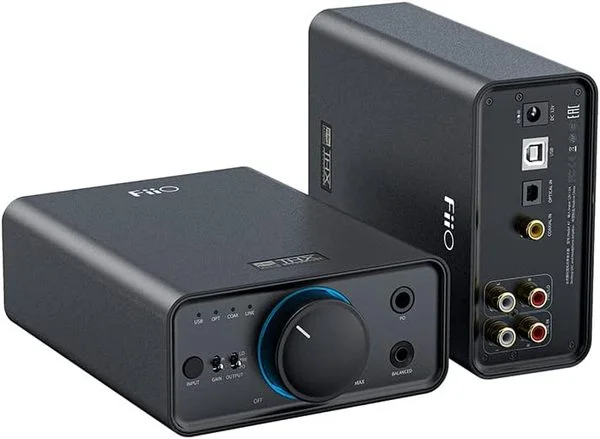
- 250–300Ω headphones: a desktop amp with 5 V or more. The FiiO K11 R2R (~$170, DAC included) or Schiit Magni (Unity) ($119, amp only). See today's price for the FiiO K11 R2R on Amazon ↗
- Low-sensitivity planars: an amp with current to spare, rated 300 mW or more into 32Ω. The K11 R2R from its balanced jack, or the Topping DX5 II (~$299) for headroom. See today's price for the Topping DX5 II on Amazon ↗
The do I need a headphone amp? page has the same table for 11 headphones with an amp pick and pairing guide for each.