Updated October 2026 · prices checked Oct 10, 2026. Amp specs are manufacturer ratings unless noted; the voltage math is shown so you can check it.
Best amp for the 250Ω DT 990 Pro: about 11 V from a single-ended jack, roughly 13 dB of headroom.
Best one-box for the 250Ω: about 11 dB of single-ended headroom plus built-in headphone EQ for the treble.
Best value one-box for the 80Ω version, and fine for the 250Ω at normal levels.
Which DT 990 Pro Do You Have?
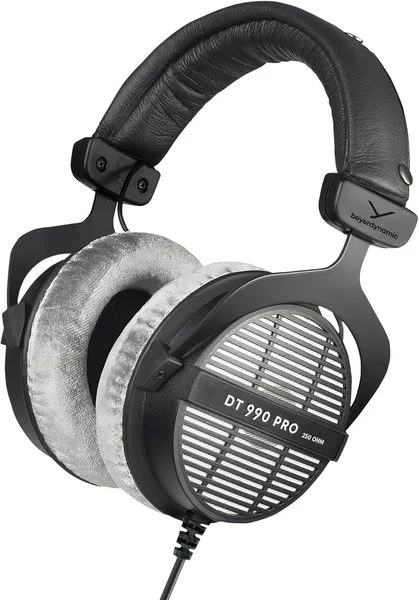
The DT 990 Pro sold in the US today is mostly the 250Ω version. Beyerdynamic also makes an 80Ω DT 990 Pro, and the older consumer DT 990 came in 32Ω and 600Ω variants. There is also a newer, low-impedance DT 990 Pro X, designed to run without an amp. This guide covers the 250Ω first and the 80Ω second, because the amp advice is different.
Beyerdynamic rates the DT 990 Pro at 96 dB/mW, the same as the DT 770 Pro. Here is what that means in volts:
| Version | Sensitivity in dB/V | Volts for 110 dB peaks | Power | With 6 dB headroom | Max source output impedance (Z/8) |
|---|---|---|---|---|---|
| DT 990 Pro 80Ω | ~107 dB/V | ~1.4 V | ~25 mW | ~2.8 V | ≤10Ω |
| DT 990 Pro 250Ω | ~102 dB/V | ~2.5 V | ~25 mW | ~5.0 V | ≤31Ω |
Why 110 dB peaks? Well-recorded music peaks 15 to 20 dB above its average, so 110 dB peaks means a loud 90 to 95 dB average. A source that can’t reach it compresses the loudest moments, and on the DT 990 that shows up as boomy, congested bass rather than the tight punch owners expect.
The cable detail that matters: like the DT 770 Pro, the DT 990 Pro has a fixed, coiled single-ended cable. Balanced outputs are useless without modifying the headphone, so only single-ended ratings count below.
DT 990 Pro 250Ω: Best Amps
Requirement: about 2.5 V for 110 dB peaks. Volts are derived from published ratings at the nearest load (usually 300Ω).
| Amp (single-ended output) | ≈ Volts into 250Ω | Headroom vs 2.5 V | Verdict |
|---|---|---|---|
| Phone / laptop / Apple USB-C dongle | ~1 V | −8 dB | Too quiet for loud listening |
| FiiO K11 R2R, 6.35mm | ~3.9 V (FiiO) | +4 dB | Fine at normal-to-loud levels |
| Topping DX5 II, 6.35mm | ~8.4–8.7 V (listed figures) | +11 dB | Comfortable |
| JDS Labs Atom Amp 2 | ~9.3 V (JDS) | +11 dB | Comfortable |
| Schiit Magni (Unity) | ~11 V (Schiit, 300Ω) | +13 dB | Comfortable |
| Schiit Valhalla 3 (OTL tube) | ~8.7 V (Schiit, 300Ω, 10% THD) | +11 dB | Works; colored by design |
Schiit Magni (Unity), $119. The best-value amp for the 250Ω: about 11 V from its ¼-inch jack, three gain settings and under 0.1Ω output impedance. It replaced the Magni Heresy and Heretic. With Schiit’s DAC card it is $199 and a complete one-box setup.
Topping DX5 II, ~$299. The one-box choice with real headroom: its single-ended jack is listed at 2.2 W into 32Ω and 250 mW into 300Ω, about 8.5 V into either. Its headphone-correction EQ is a practical bonus for this headphone in particular, since EQ is the dependable way to tame the DT 990’s treble.
FiiO K11 R2R, ~$170. About 3.9 V from the 6.35mm jack, 4 dB above the 110 dB requirement. It works for normal listening; if you play dynamic music loud, it’s the box that runs out first, and its stronger balanced output doesn’t help with a fixed cable.
JDS Labs Atom Amp 2, ~$129. The neutral alternative to the Magni, with similar headroom. Buy whichever is in stock.
DT 990 Pro 80Ω: Best Amps
Requirement: about 1.4 V. A phone or Apple USB-C dongle at about 1 V reaches roughly 107 dB peaks, which is loud enough for most listening. The FiiO K11 R2R adds about 9 dB of headroom and a sub-1Ω output impedance, well inside the 80Ω version’s 10Ω limit; that matters on laptops with high-impedance headphone jacks, which can loosen the bass. A Magni or DX5 II is far more than the 80Ω needs unless you plan to add a harder load.
Warm vs Neutral Amps: What Actually Changes the Treble
The DT 990 Pro is a V-shaped headphone with a pronounced treble peak that some listeners find exciting and others find fatiguing. Older versions of this guide recommended “warm” solid-state amps to soften it. The honest picture is less convenient:
- Competent solid-state amps measure nearly flat across the audio band into a 250Ω load. Published measurements of amps in this class show frequency-response deviations far smaller than the DT 990’s treble peak. A different solid-state amp will not remove it.
- EQ is the dependable fix. Owners commonly apply a cut of a few dB in the 8 to 10 kHz region with Equalizer APO, Wavelet, or an amp with built-in EQ such as the DX5 II. It’s free, precise and reversible.
- An OTL tube amp is the one amp type that changes the sound noticeably. The 250Ω DT 990 is a workable OTL load: the Valhalla 3’s 25Ω low-gain setting stays inside the 31Ω limit. Expect a small bass lift from the impedance interaction and the softer presentation tubes are known for. It’s a character choice, not a treble correction. Background: tube amp vs solid state .
The Old Picks and What Replaced Them
This guide used to recommend the JDS Labs Atom Amp+, the FiiO K7 and the Schiit Asgard 3. The Atom Amp+ has been superseded by the Atom Amp 2; the Asgard 3 is no longer in Schiit’s lineup (the Asgard X replaced it at $399); and the FiiO K7 is no longer listed on FiiO’s site but still sells at about $220 ( See today's price for the FiiO K7 on Amazon ↗ ). If you own any of them, keep it: all three drive the 250Ω DT 990 with headroom to spare.
Best Uses for the DT 990 Pro
- Gaming: popular, thanks to the wide presentation; add a separate mic. On consoles, prefer the 80Ω or a USB DAC/amp.
- Electronic music and film scores: the V-shape suits them.
- Critical listening and mixing: not recommended. The elevated bass and treble mislead flat mixing work; the DT 990 vs DT 880 comparison covers the more neutral sibling.
Who Should Skip What
- Skip the 250Ω if you won’t buy an amp; get the 80Ω or the DT 990 Pro X.
- Skip the K11 R2R for the 250Ω if you listen loud.
- Skip balanced amps bought for this headphone: the fixed cable makes their balanced output irrelevant.
- Skip “warm” amps bought to fix the treble: use EQ.
What Owners Say (as of October 2026)
On r/headphones and Head-Fi, the recurring DT 990 Pro pattern is consistent: 250Ω owners running from a console or phone describe it as quiet and flat, and adding any desktop amp fixes that; the treble divides people, and EQ is the most common answer in those threads; and the DT 990 is regularly recommended for gaming and regularly not recommended for mixing. If you are still choosing between Beyerdynamics, see DT 770 vs DT 990 and the DT 770 Pro 80Ω vs 250Ω comparison, which applies to the DT 990’s impedance versions too.
Want the full breakdown on this headphone? Read our Beyerdynamic DT 990 Pro review , or see the DT 770 Pro pairing guide for the closed-back version.