Updated October 2026 · prices checked Oct 10, 2026. Discontinued amps replaced with current models; specs are manufacturer ratings unless noted.
The short answer
Best desktop value: 2.5 W into 32Ω, about 15 dB above the HE400SE's 110 dB requirement, for $119.
Best budget one-box, used with a 4.4mm balanced cable: 1.3 W into 32Ω, about 12 dB of headroom.
One-box with 14 to 19 dB of headroom that stays relevant after you upgrade the headphone.
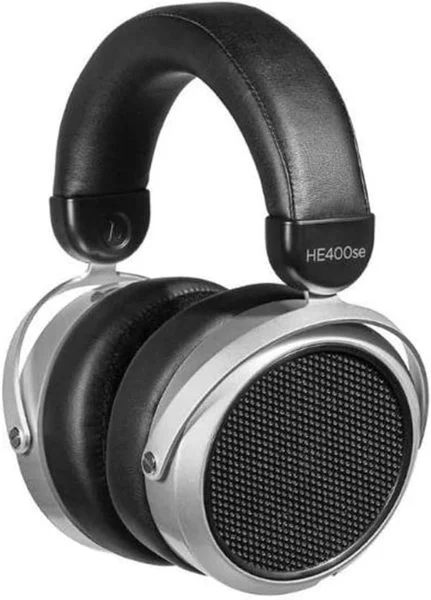
The HiFiMAN HE400SE needs about 80 mW at 25Ω for 110 dB peaks and roughly 320 mW for 6 dB of headroom, with 56 to 113 mA of current behind it. That kills phone jacks and the Apple dongle, and it’s why the “25 ohms, must be easy” assumption leads so many buyers to think this planar is bass-light and dull.
Cheapest fix: a FiiO KA5 dongle through its 4.4mm balanced jack. Best desktop value: Schiit Magni (Unity) ($119) or JDS Labs Atom Amp 2 ($129). Best budget one-box: FiiO K11 R2R ($170) with a balanced cable. If a Sundara or Arya is in your future, the Topping DX5 II or Schiit Jotunheim 3 means buying the amp once.
The recommendations below come from the power math, manufacturer specs and long-running owner consensus. Where a claim is about how something sounds, it’s attributed to owners rather than presented as our own listening.
Why the HE400SE is harder to drive than its impedance suggests
Two specs decide how hard a headphone is to drive: impedance (Ω) and sensitivity (dB/mW or dB/V). Most people only read the first one. The HE400SE is 25Ω, lower than an ATH-M50x, so it “should” run from anything. But it’s rated at 91 dB/mW, and that number is the story.
Convert to voltage sensitivity: 91 dB/mW at 25Ω is 107 dB/V. A Sennheiser HD 600 is about 102 dB/V at 300Ω; an ATH-M50x is around 113 dB/V. So per volt the HE400SE is louder than the HD 600, but it draws that volt across 25Ω instead of 300Ω, which means 12× the current for the same voltage. It doesn’t need much voltage. It needs current, and current is what small output stages run out of first.
Planar magnetic drivers make this worse in one specific way: their impedance is essentially flat and resistive, so the amp sees a constant 25Ω load at all frequencies. There’s no impedance rise in the bass to give the amp a break, which is exactly where dynamic headphones ease off. For more on the physics, see the planar magnetic vs dynamic headphones guide ; for the impedance side, read what is headphone impedance .
The power math: what the HE400SE actually needs
Formula: V = 10^((SPL − S_dBV)/20), where S_dBV = 91 + 10·log10(1000/25) = 107.0 dB/V.
| Target | Voltage | Current | Power @25Ω |
|---|---|---|---|
| 100 dB (loud sustained) | 0.45 V | 18 mA | 8 mW |
| 110 dB peaks (the target used on this site) | 1.41 V | 56 mA | 80 mW |
| 110 dB + 6 dB headroom | 2.82 V | 113 mA | 318 mW |
| Output impedance rule | — | — | Z_out ≤ 25/8 ≈ 3Ω |
Two takeaways. First, 80 mW sounds trivial until you notice that a phone or an Apple dongle tops out at roughly 1 V, about 40 mW into 25Ω with no headroom at all. Second, 113 mA of clean current is beyond what USB-bus-powered single-ended dongles deliver; balanced dongles get there because they double the voltage swing across the load.
How the amps stack up
Manufacturer figures at the nearest published impedance (usually 32Ω). Headroom is calculated against the 80 mW / 1.41 V requirement for 110 dB.
| Amp | Rated output (nearest to 25Ω) | Headroom vs 110 dB | Verdict |
|---|---|---|---|
| Apple USB-C dongle | ~1 V max, ≈30 mW @32Ω (ASR measurements) | −3 dB (can’t reach 110 dB) | Skip |
| FiiO KA3 | 130 mW SE / 240 mW bal @32Ω (FiiO) | +2 dB SE / +5 dB bal | OK balanced only |
| FiiO KA5 | ~128 mW SE / ~265 mW bal @32Ω (FiiO) | +2 dB SE / +5 dB bal | Good balanced |
| iFi Zen DAC 3 | ~210 mW SE / ~390 mW bal @32Ω (iFi) | +4 dB SE / +7 dB bal | Good balanced |
| FiiO K11 R2R | 460 mW SE / 1.3 W bal @32Ω (FiiO) | +8 dB / +12 dB | Pass; best balanced |
| FiiO K7 | ~1.2 W SE / 2 W bal @32Ω (FiiO) | +12 dB / +14 dB | Pass |
| Topping DX5 II | 2.2 W SE (listed in reviews) / 6.4 W bal @32Ω (Topping) | +14 dB / +19 dB | Pass |
| Schiit Magni (Unity) | 2.5 W @32Ω, 3 W @16Ω (Schiit) | +15 dB | Pass |
| JDS Labs Atom Amp 2 | 2.65 W @32Ω (JDS) | +15 dB | Pass |
| Schiit Asgard X | 2.8 W @32Ω, 3.4 W @16Ω (Schiit) | +15 dB | Pass |
| Schiit Jotunheim 3 | 2 W SE / 6 W bal @32Ω (Schiit) | +14 dB / +19 dB | Pass (overkill) |
Everything from the K11 R2R’s balanced output up passes with 12 dB or more of margin. The interesting zone is the dongles: single-ended they scrape past 110 dB with 2 dB to spare, which in practice means compression on kick drums at high volume. Balanced they’re fine.
Why dongles clip on the HE400SE
A USB-C dongle has a hard voltage ceiling set by its internal supply: around 1 V for the Apple stick, roughly 2 V single-ended and 4 V balanced for FiiO’s KA series. The voltage ceiling sets maximum SPL. When a track’s peaks ask for more voltage than the chip can swing, the waveform flat-tops. On a planar that shows up as bass that stays polite no matter how far you turn it up, and a sense that the volume knob “stops working” near the top.
The Apple dongle is the clearest case: ~1 V into 25Ω is 107 dB. You can listen at 90 to 95 dB average, but the 15 to 20 dB transients above that in well-recorded music are gone. That’s why so many people say the HE400SE “has no bass” from a phone. It’s not the headphone. For a pocket solution, buy a balanced dongle and a 4.4mm cable, or a Bluetooth DAC/amp with a balanced output such as FiiO’s current BTR17 ( See today's price for the FiiO BTR17 on Amazon ↗ ), which replaced the BTR7 as FiiO’s flagship in that line. Check the balanced rating against the 80 mW requirement before you buy any portable unit.
Why low output impedance matters (even on a flat-impedance planar)
The usual argument for low output impedance is frequency response: a headphone whose impedance varies with frequency will change tonality when driven from a high-impedance source. Planars barely vary, so that argument mostly evaporates for the HE400SE.
The argument that still stands is voltage division. Any output impedance forms a divider with the 25Ω load. A 10Ω source drops 29% of its voltage before it reaches the driver: 3 dB gone, on a headphone that already needed all the voltage it could get. Console controllers, some motherboard jacks and OTL tube amps sit in that range or worse. Every amp on the tier list is at or under 1Ω, so the rule (Z_out ≤ 3Ω for a 25Ω load) is easily met. Just don’t run this on an OTL tube amp.
Why balanced helps here (and where it doesn’t)
Balanced output on affordable gear typically doubles the voltage swing into the load and delivers several times the power. On the FiiO K11 R2R that’s the difference between 460 mW and 1.3 W into 32Ω; on a KA5 dongle it’s the difference between “barely enough” and “comfortable.” Because the HE400SE’s problem is headroom, balanced solves the actual problem on power-limited devices.
On a desktop amp that already puts 2.5 W or more into 32Ω single-ended (Magni (Unity), Atom Amp 2, Asgard X), a balanced cable buys you nothing measurable at the levels anyone listens at. The balanced vs single-ended guide explains why, and the best balanced headphone amps roundup covers the options if you want the connector anyway. The HE400SE uses dual 3.5mm cup connectors, so a balanced aftermarket cable is cheap and easy to find.
The amps, one by one
Apple USB-C dongle (~$9): why not
ASR’s measurements show about 1 V RMS maximum output and roughly 30 mW into 32Ω, with an output impedance under 1Ω. A great DAC for the money and the wrong tool for a 91 dB/mW planar. It reaches 107 dB peaks at best, so you live with zero headroom. Fine for IEMs and the ATH-M50x. Not for this.
FiiO KA3 / KA5: the pocket answer
Both have a 4.4mm balanced jack rated at 240 to 265 mW into 32Ω per FiiO, plus a 3.5mm at roughly half that. Balanced, they clear the 110 dB target with 5 dB of headroom, which is enough for most listening. The KA5 adds a screen and hardware volume; the KA3 is smaller. Neither is a desktop replacement, and both draw noticeable battery from a phone. Use the 4.4mm. See today's price for the FiiO KA3 on Amazon ↗
Schiit Magni (Unity) ($119): the desktop value pick
This is the current Magni. Schiit retired the Magni Heresy and Heretic that this guide used to recommend and replaced them with this single model: 3 W into 16Ω, 2.5 W into 32Ω, output impedance under 0.1Ω, three gain settings and a preamp out. The 16Ω figure is the useful one for a planar, because it shows the output stage keeps delivering current as impedance drops. With Schiit’s DAC card it’s $199 as a one-box. The older Magni Heresy review and Heresy vs Atom Amp+ comparison remain useful if you’re shopping used.
JDS Labs Atom Amp 2 (~$129): the neutral alternative
The Atom Amp+ successor. JDS rates it at 2.65 W into 32Ω with 0.7Ω output impedance: the same class of result as the Magni on this headphone, from a different chassis and knob. Pair it with a Topping E30 II or Schiit Modi 5 for a complete stack.
FiiO K11 R2R (~$170): the budget one-box, used balanced
R2R DAC plus amp. Single-ended, 460 mW into 32Ω gives about 8 dB of headroom, which is workable. Balanced, 1.3 W gives about 12 dB, which is comfortable. With a cheap 4.4mm cable for the HE400SE’s dual 3.5mm connectors, this is the least expensive one-box that drives it properly.
Topping DX5 II (~$299): the one-box you keep
The replacement for the Topping DX3 Pro+, which retailers now list as discontinued. 2.2 W into 32Ω from the 6.35mm jack as listed in reviews, 6.4 W balanced by Topping’s rating, plus headphone-correction EQ and Bluetooth. Far more than the HE400SE needs; worth it if the HE400SE is a step toward a Sundara, Arya or Edition XS. The DX3 Pro+ review covers the predecessor.
FiiO K7 (~$220): the older balanced combo
No longer listed on FiiO’s site but still sold. About 1.2 W single-ended and 2 W balanced into 32Ω, an AKM DAC and a preamp out. It still drives the HE400SE comfortably, but at roughly $50 more than the K11 R2R it has lost its price advantage. See today's price for the FiiO K7 on Amazon ↗ FiiO K7 review .
iFi Zen DAC 3 (~$229): the warm alternative
Balanced only for this headphone: iFi’s ~390 mW into 32Ω from the 4.4mm passes with 7 dB of headroom, but the single-ended jack (~210 mW) leaves you at 4 dB. The XBass switch adds sub-bass lift, which is useful on a headphone that rolls off gently below 40 Hz. Owners who find the HE400SE thin often recommend it for that switch. Zen DAC 3 review ; Zen DAC 3 vs DX3 Pro+ .
Schiit Asgard X ($399): Class A, more than needed
The Asgard 3’s replacement, which Schiit describes as a big departure from the old design: 2.8 W into 32Ω and 3.4 W into 16Ω from the ¼-inch jack, a Class A-biased output stage with no feedback, a 4.4mm output and a preamp. Owners of the old Asgard 3 often described it as fuller-sounding with this headphone; whether the new design does the same is not yet settled by published measurements or owner consensus. Buy it for the build and features.
Schiit Jotunheim 3 ($499): the amp you don’t outgrow
6 W into 32Ω balanced, 2 W single-ended, under 1Ω output impedance, optional DAC card. For the HE400SE alone it’s overkill by 19 dB. Buy it if you know a Sundara, Arya or Edition XS is next. It also fills the slot the Drop THX AAA 789 used to hold on this list; the 789 has had no retail channel since Drop closed in March 2026. The THX AAA 789 review is still there for used buyers.
Amp character: does the HE400SE care about warm vs neutral?
Less than a Beyerdynamic DT 990 Pro, more than an HD 600. Owners describe the HE400SE as close to neutral with a slight lower-midrange dip and some grain in the upper treble. Competent solid-state amps measure nearly flat into a 25Ω resistive load, so swapping one for another changes little. The tools that do change the balance are EQ and features like the Zen DAC 3’s XBass switch.
Tube amps are the exception: OTL designs have output impedances of 25 to 120Ω, which drop most of their voltage across themselves into a 25Ω load and roll off the bass. If you’re curious about tubes, use them with 250 to 300Ω dynamics; the tube vs solid-state guide explains why.
Skip this pairing if…
- You want to run the HE400SE from a phone with no extra hardware. It’ll be quiet, compressed and bass-shy. Either buy a balanced dongle or buy an easier headphone: the ATH-M50x or Sennheiser HD 560S run from almost anything.
- You already own a Sundara. Same amps apply; read the Sundara pairing guide . The Sundara is 3 dB easier and the priorities shift.
- You want a tube amp. Not with a 25Ω planar. Get a 300Ω Sennheiser for that.
- You expect an amp to fix the treble. It won’t. EQ or a different headphone will.
- You’re on a strict $150 total budget. Get the HE400SE plus a balanced dongle rather than a no-name amp, or see the best planar magnetic headphones under $300 for a headphone-first spend.
What owners say (as of October 2026)
Across years of HE400SE threads on r/headphones and Head-Fi, the consensus is consistent: people who bought it as their first planar and ran it from a laptop were underwhelmed; people who added a desktop amp or a balanced dongle describe the same headphone as a bargain. Reported amp upgrades past that point mostly mention tighter bass and more punch, and almost nobody claims a change in treble or soundstage. Complaints center on the stock cable, headband comfort on earlier units, and treble grain, none of which an amplifier touches. The Sundara is the standard “next step,” and the HE400SE vs Sundara comparison is the article to read before you spend that money.
Recommendation by budget
| Budget | Buy | Why |
|---|---|---|
| Portable | FiiO KA5 or KA3 (4.4mm) | Cheapest options that clear 110 dB with headroom, balanced only |
| ~$120, have a DAC | Schiit Magni (Unity) or Atom Amp 2 | About 2.5 W into 32Ω, ~15 dB of headroom |
| ~$170, no DAC | FiiO K11 R2R + balanced cable | 1.3 W balanced, ~12 dB of headroom |
| ~$200, no DAC | Schiit Magni (Unity) with DAC card | One Schiit box, ~15 dB single-ended |
| ~$300, no DAC | Topping DX5 II | 14 to 19 dB of headroom, upgrade-proof |
| $500+ | Schiit Jotunheim 3 + Modi 5 or E30 II | Never buy another amp |
Whichever tier you pick, spend the rest on music. The HE400SE plus a ~$120 amp is still one of the best-value chains in headphones. It just isn’t a plug-into-your-phone headphone, and no amount of forum optimism changes the current draw.
Related reading: the HiFiMAN HE400SE review , HE400SE vs Sundara , do I need a headphone amp? , and the best headphone amps under $200 for a wider field.
See today's price for the HiFiMAN HE400SE on Amazon ↗