Updated October 2026 · prices checked Oct 10, 2026. Discontinued amps (Magni Heresy, Atom Amp+, DX3 Pro+, Asgard 3, THX 789) replaced with current models; the power math is unchanged.
The Short Answer
Best amp if you have a DAC: about 11 V into 300Ω, 13 dB above the HD 600's 110 dB peak requirement, under 0.1Ω output impedance.
Best value if you need a DAC too. Use the 4.4mm balanced output (about 8.1 V) for full headroom; the 6.35mm jack (about 3.9 V) is fine at normal levels.
One box with headroom on every output, and the amp you keep when a planar joins the HD 600.
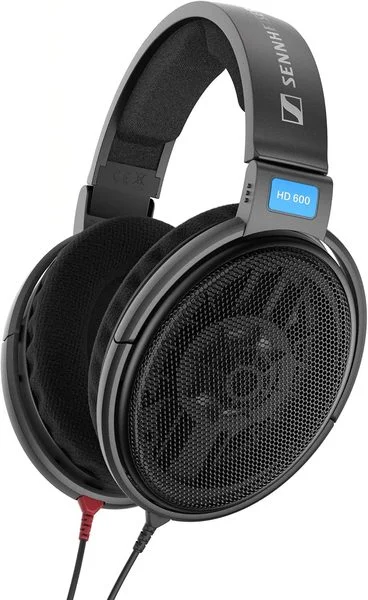
The Sennheiser HD 600 is a 300Ω, 97 dB/mW dynamic headphone. It needs about 2.45 V RMS and 20 mW to hit 110 dB peaks. That is a trivial amount of power, but more voltage than a phone or laptop jack delivers, and that single fact explains almost every “the HD 600 sounds thin” complaint on the internet.
The one-line recommendation: buy a Schiit Magni (Unity) ($119) or JDS Labs Atom Amp 2 ($129) if you have a DAC, or a FiiO K11 R2R ($170) if you’d rather have one box. Everything above that price is about outputs, character, features and future headphones, not about “unlocking” the HD 600.
Below: the power math for every amp in the list, why the HD 600 wants a neutral amp first and a tube amp second, what changes for the HD 650, and who should skip each tier.
For the headphone itself, read the Sennheiser HD 600 review ; for the sibling comparison, HD 600 vs HD 650 .
Why 300Ω Needs Voltage, Not Watts
People talk about the HD 600 as “power hungry.” It isn’t. Here is the arithmetic used for every pairing guide on this site.
- Sensitivity: 97 dB/mW at 300Ω. Convert to dB/V: 97 + 10·log10(1000/300) = 102.2 dB/V.
- Voltage for 110 dB peaks: 10^((110 − 102.2)/20) = 2.45 V RMS.
- Current: 2.45 / 300 = 8.2 mA. Power: 2.45² / 300 = 20 mW.
- With 6 dB of headroom (2× voltage): 4.9 V, 16 mA, 80 mW.
Twenty milliwatts is nothing. Eight milliamps is nothing. What defeats phones and dongles is the 2.45 V: most of them are limited to about 1 V (US Apple dongle) or 0.5 V (EU-limited devices and many laptops). At 1 V the HD 600 peaks around 102 dB. That’s a comfortable average level, but there’s no room left for a snare hit or a crescendo. The sound gets described as “flat,” “distant,” “no bass.” Really it’s compression at the top of the source’s swing.
The other rule to check: output impedance ≤ Z_headphone / 8, so 37.5Ω or less for the HD 600. Every solid-state amp below is under 1Ω. The OTL tube amp deliberately bends this rule, and that is the whole point of that section.
For the longer version of these two ideas, see What Is Headphone Impedance? and Do I Need a Headphone Amp? .
Power Math: Every Amp vs the HD 600’s Requirement
Requirement: 2.45 V / 20 mW for 110 dB peaks. Headroom = how far the amp’s rated output at 300Ω sits above that. Figures are manufacturer specs unless stated; volts are derived from published power (V = √(P × 300)).
| Amp | Rated output @ 300Ω | ≈ Volts | Headroom vs 2.45 V | Zout | Verdict |
|---|---|---|---|---|---|
| Apple USB-C dongle | ~1 V RMS (ASR measurement) | 1.0 V | −8 dB (peaks ~102 dB) | <1Ω | Marginal, quiet listening only |
| FiiO K11 R2R, 6.35mm | 50 mW (FiiO) | 3.9 V | +4 dB | <1Ω | Fine at normal levels |
| FiiO K11 R2R, 4.4mm balanced | 220 mW (FiiO) | 8.1 V | +10 dB | <1.5Ω | Comfortable |
| JDS Labs Atom Amp 2 | 286 mW / 9.27 V (JDS) | 9.3 V | +12 dB | 0.7Ω | Excellent |
| Schiit Magni (Unity) | 415 mW (Schiit) | 11.2 V | +13 dB | <0.1Ω | Excellent |
| Schiit Asgard X, ¼-inch | 380 mW (Schiit) | 10.7 V | +13 dB | 0.7Ω | Excellent |
| Schiit Midgard | 750 mW (Schiit) | 15.0 V | +16 dB | <0.1Ω | Excellent |
| Topping DX5 II, 6.35mm | 250 mW (as listed in reviews) | 8.7 V | +11 dB | n/a | Excellent |
| Topping DX5 II, balanced | 990 mW (Topping) | 17.2 V | +17 dB | n/a | Overkill |
| Schiit Jotunheim 3, balanced | 1.2 W (Schiit) | 19.0 V | +18 dB | <0.8Ω | Overkill in the best way |
| Schiit Valhalla 3 (OTL) | 250 mW at 10% THD (Schiit) | 8.7 V | +11 dB | 25 / 40 / 60Ω | Works, colored by design |
Read this table honestly: every desktop amp on the list clears the requirement by 10 dB or more on at least one output. The differences you hear between them are not “power.” They are output impedance (flat for all the solid-state units), noise floor (inaudible on all of them with a 97 dB/mW headphone), gain structure (where the knob sits), and, in the tube case, deliberate coloration.
The Picks, Tier by Tier
Tier 0: Apple USB-C dongle (~$9): marginal, not useless
Audio Science Review’s measurements put the US-market dongle at about 1 V RMS into a high-impedance load, with distortion and noise that embarrass some $200 products. Into the HD 600 that’s a ~102 dB ceiling. For a quiet room, spoken word or background jazz it is fine, and it hisses less than most laptop jacks.
Where it falls apart is dynamic material at real listening levels. You raise the volume to get the average where you like it, and the peaks stop growing. That’s the “the HD 600 has no bass” experience. It isn’t the headphone.
Skip if: this is your only source and you listen above quiet-room levels. Fine if: it’s the travel backup for a headphone that lives on a desktop amp at home.
Tier 1: Schiit Magni (Unity) ($119)
This is the current Magni. Schiit retired the Magni Heresy and Heretic and replaced both with this single model, rated at 415 mW into 300Ω with output impedance under 0.1Ω. That is about 11 V, 13 dB above the HD 600’s requirement. It has three gain settings (use the lowest one that reaches your level, so the knob sits in a usable range), a preamp output, and Schiit sells it for $199 with its DAC card installed if you want one box.
On paper it is the same class of result as the Heresy that this page used to recommend. If you own a Heresy, nothing here is a reason to replace it. The old Magni Heresy review remains useful if you’re shopping used.
Skip if: you want the DAC in the same box from another brand (get the K11 R2R) or you already know you want tube warmth.
Tier 1 alternative: JDS Labs Atom Amp 2 (~$129)
The Atom Amp+ has been superseded by the Atom Amp 2. JDS rates it at 286 mW (9.27 V) into 300Ω, with 0.7Ω output impedance. That’s 12 dB of headroom on the HD 600. At matched levels there is no electrical reason to expect an audible difference from the Magni on this headphone; pick on price, stock and which volume knob you prefer. JDS sells it direct. The old Atom Amp+ review and the Magni Heresy vs Atom Amp+ comparison still describe the design approach of both brands.
Tier 2: FiiO K11 R2R (~$170): the budget one-box answer
The K11 R2R combines a resistor-ladder DAC with a headphone amp and three gain settings. The detail that matters for the HD 600 is the difference between its outputs. FiiO rates the 4.4mm balanced output at 220 mW into 300Ω (about 8.1 V, +10 dB) and the 6.35mm jack at 50 mW (about 3.9 V, +4 dB).
Four dB above 110 dB peaks is enough for most people at most volumes with the stock cable. If you like it loud, a 4.4mm balanced cable for the HD 600 quadruples the available power. It is the box to recommend to someone who wants to plug in a USB cable and be done.
The FiiO K7 (~$220) is the older one-box alternative. It is no longer listed on FiiO’s site but is still sold. FiiO rates it at 2 W into 32Ω balanced and about 1.2 W single-ended; at roughly $50 more than the K11 R2R it no longer has a clear price advantage. See today's price for the FiiO K7 on Amazon ↗ Review: FiiO K7 review .
Skip if: you already own a decent DAC. You’d be paying for a second one.
Tier 3: Topping DX5 II (~$299): one-box with headroom to spare
The DX5 II is the current replacement for the DX3 Pro+, which retailers now list as discontinued. Topping rates its balanced outputs (4.4mm and 4-pin XLR) at 990 mW into 300Ω, about 17 V; the single-ended 6.35mm jack is listed at 250 mW in reviews, about 8.7 V, so even the stock HD 600 cable gets 11 dB of headroom. It also has Bluetooth, a remote and headphone-correction EQ.
The HD 600 doesn’t need this much amp. Buy it if you want one box that will also drive a demanding planar later. The older DX3 Pro+ review covers its predecessor.
Skip if: the HD 600 is your only headphone and you want maximum value. The K11 R2R or a Magni gets you there for less.
Tier 4: Schiit Asgard X ($399): the Class A solid-state option
The Asgard X replaced the Asgard 3. It has a discrete, Class A-biased output stage with no feedback, a ¼-inch output rated at 380 mW into 300Ω (about 10.7 V), a 4.4mm output, two gain settings and a preamp out. That is essentially the same voltage as the $119 Magni. What you pay for is the design, the second output and the preamp section.
Owners of the old Asgard 3 often described it as adding a little lower-midrange weight to the HD 600. Whether the very different Asgard X does the same is not something published measurements can settle, so treat any “warmer” claim with caution. If you want a mid-price Schiit amp with more power than the Magni, the Midgard ($219, 750 mW into 300Ω) sits in between.
Skip if: you’re buying it for “more power.” The Magni has the same voltage into 300Ω.
Tier 5: OTL tubes: Schiit Valhalla 3 ($499), Bottlehead Crack, Darkvoice 336SE
OTL (output-transformerless) tube amps have high output impedance (25 to 60Ω on the Valhalla 3 depending on gain and feedback, about 120Ω for the Bottlehead Crack per Bottlehead) and limited current. That makes them wrong for 32Ω headphones and planars. The 300Ω Sennheisers are the exception that made them famous.
Two things happen with a 300Ω Sennheiser:
- Impedance interaction. The HD 600’s impedance isn’t flat: it rises well above 300Ω around its bass resonance near 100 Hz. A high-Zout amp forms a voltage divider with the headphone, so a little more voltage lands on the driver where impedance is highest, and a mild bass shelf appears. With the Valhalla 3’s 25 to 60Ω, that shelf is under 1 dB; the Crack’s ~120Ω roughly doubles it. On a 32Ω headphone the same effect would be a mess.
- Harmonic profile. Low-order (mostly second) harmonic distortion at levels a solid-state designer would call a defect, and less electrical damping. Owners describe the result as softer, denser, “rounder.” The HD 600’s slightly forward upper mids get a bit of cushion.
Voltage swing isn’t a problem. These amps deliver plenty of volts into 300Ω (the Valhalla 3 is rated at 250 mW, about 8.7 V, at 10% THD); it’s current into low-impedance loads they lack. The Crack is a DIY kit; the 336SE is plug-and-play and has a known hum issue that owners address with tube swaps. Background: Tube amp vs solid state .
Skip if: you also own low-impedance headphones or planars, want a single amp for everything, or want the HD 600’s honesty rather than a flattering version of it.
Tier 6: Schiit Jotunheim 3 ($499): high-end balanced
The Jotunheim 3 replaced the Jotunheim 2, and for this page it also takes the slot the Drop THX AAA 789 used to fill (Drop closed in March 2026, and the 789 has no retail channel). Schiit rates it at 1.2 W into 300Ω balanced (about 19 V) and 330 mW single-ended, with output impedance under 1Ω on both outputs and an optional DAC card.
On the HD 600 alone, it’s the same headphone as on a Magni with far more knob range. You don’t buy the Jotunheim 3 for the HD 600. You buy it because you want one amp that also handles the planar you’ll buy next year. If you own a THX 789, keep it; it clears the HD 600’s requirement by a huge margin.
Skip if: the HD 600 is your only headphone. A $119 amp gets you the same sound.
Amp Character: Neutral vs Warm/OTL, Which Way to Go First
My rule for the HD 600 is: neutral first, colored second.
The HD 600 is already a hair warm of flat with a slightly forward upper midrange. Piling a warm amp on top before you know the headphone is how people end up with “cloudy” impressions and no reference point. Live with it on a Magni, Atom Amp 2 or K11 R2R for a few months. Then you’ll know whether what you want is:
- a bass lift and softer treble → an OTL tube amp;
- more outputs and room for a planar → DX5 II or Jotunheim 3;
- nothing, actually → you’re done, which is what owners most often report.
That “most owners stop upgrading” pattern is the consistent forum consensus on HD 600 threads.
What Changes vs the HD 650
Same 300Ω, same driver family, essentially the same voltage requirement (the HD 650’s 103 dB/V works out to 2.24 V for 110 dB vs 2.45 V here). Every amp in the table applies to both. What flips is the character advice:
- The HD 650 is thicker and warmer, with a more relaxed upper midrange. It tolerates, and many owners prefer, the OTL tube coloration from day one. That’s why the HD 650 / HD 6XX pairing guide puts the Valhalla 3 among its main picks.
- The HD 600 is drier and more neutral. Tube warmth is a legitimate second amp; a neutral solid-state amp is the right first one.
- Both are effectively immune to noise-floor problems (97 dB/mW is not sensitive), and both punish underpowered sources the same way.
If you’re still deciding between the two headphones, HD 600 vs HD 650 is the comparison; for the newer, lower-impedance model, see HD 600 vs HD 660S2 . The discontinued Drop HD 58X (150Ω, easier) has its own guide: best amp for HD 58X .
Skip If: Who Should Not Buy Which Tier
- Skip the dongle if the HD 600 is your main headphone. It’s a backup, full stop.
- Skip the K11 R2R’s 6.35mm jack as a long-term setup if you listen loud to dynamic material; add a 4.4mm cable or buy the Magni.
- Skip the Asgard X if you’re buying it for “more power.” The Magni has the same voltage into 300Ω.
- Skip OTL tubes if you own low-impedance headphones, need silence between tracks (some tube amps hum), or haven’t yet heard the HD 600 on a neutral amp.
- Skip the Jotunheim 3 and DX5 II if the HD 600 is your only headphone; you’d be paying for a knob you never turn past nine o’clock.
- Skip balanced anything if the only reason is the HD 600. See balanced vs single-ended .
Adding a DAC
Once the amp is sorted, the DAC is the next question. Two honest points: with a proper amp, the DAC is not what’s holding the HD 600 back, and differences between competent DACs are small on this headphone. Options, in the order I’d consider them:
- Topping E30 II : the measurement-first choice to put under a Magni or Atom Amp 2. See today's price for the Topping E30 II on Amazon ↗
- Schiit Modi 5 ($149): the current Modi, and the natural match for a Magni stack. The Modi Multibit that HD 600 owners used to recommend is discontinued; Schiit now offers its Multibit design as a DAC card for its modular units. See today's price for the Schiit Modi 5 on Amazon ↗ See today's price for the Schiit Modi 5 from Schiit ↗
- SMSL SU-1 : if you’d rather put the money into the amp. See today's price for the SMSL SU-1 on Amazon ↗
The full ranking is at best DAC under $200 , and the one-box options at best DAC/amp combo under $300 .
Complete Chains at Four Budgets
| Budget | Chain | Approx. total | Notes |
|---|---|---|---|
| ~$120 | Laptop/motherboard → Schiit Magni (Unity) or Atom Amp 2 | $119–$129 | Fixes the voltage problem; DAC later |
| ~$170 | FiiO K11 R2R (USB in) | ~$170 | One box; add a 4.4mm cable for full headroom |
| ~$200 | Schiit Magni (Unity) with DAC card | $199 | One Schiit box, 13 dB of headroom single-ended |
| ~$300 | Topping DX5 II | ~$299 | Balanced and single-ended headroom to spare; planar-ready |
| ~$650 | Schiit Modi 5 → Jotunheim 3, or → Valhalla 3 | ~$650 | Neutral end-game, or the tube flavor |
What Owners Say (as of October 2026)
The consensus from years of HD 600 threads on r/headphones, Head-Fi and the Audio Science Review forum, condensed: the jump from a phone or laptop to any competent desktop amp is large and nearly everyone reports hearing it; the jump from that amp to a $300 to $500 solid-state amp is small and many people don’t; the jump to an OTL tube amp is audible but polarizing, described as “richer” by people who keep the tube amp and “slower and softer” by those who go back. Reports of the HD 600 hissing on any desktop amp are rare, and regret over buying the headphone is rarer still.
Final Recommendation
Buy the HD 600. Put a Magni (Unity) or Atom Amp 2 under it, or a K11 R2R if you want one box. Listen for three months. If you’re still curious, an OTL tube amp is the one upgrade that changes the sound in a way you can describe; the DX5 II and Jotunheim 3 are for when your headphone collection grows, not because the HD 600 asked for them.
Related: Sennheiser HD 600 review · Best amp for HD 650 / HD 6XX · Best amp for HD 560S · Headphone amp reviews, ranked · How we research