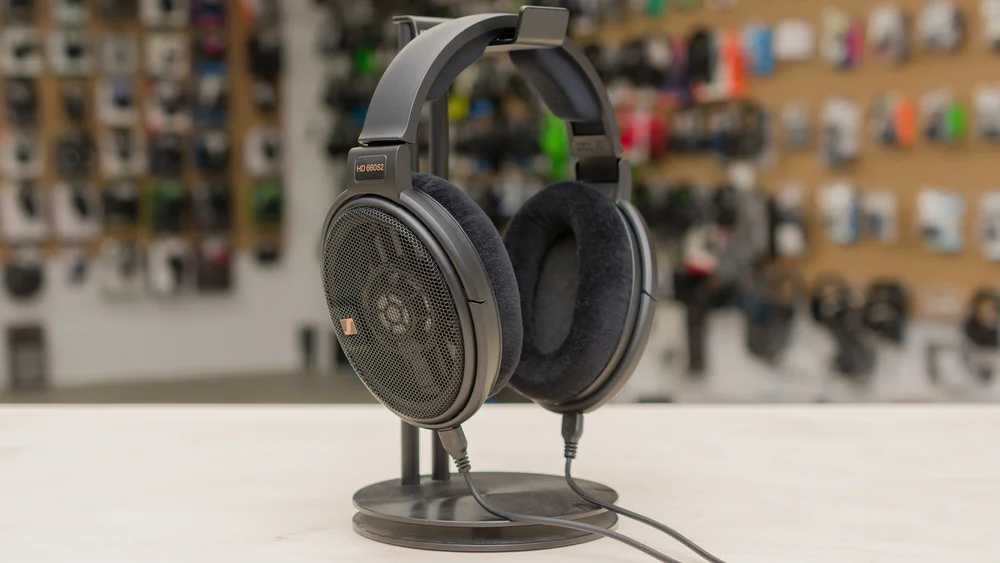
Published October 2026 · prices checked Oct 10, 2026. Amp specs are manufacturer ratings unless noted; the voltage math is shown so you can check it. AmperHeads does not bench-test gear: picks come from published specs, measurements and owner reports. How we research .
Current Picks
Best one-box: plug in the HD 660S2's included 4.4mm cable for about 17 V into 300Ω (+19 dB). The 6.35mm jack still gives +13 dB.
Best value: the included balanced cable unlocks the K11 R2R's strong 4.4mm output, about 8 V into 300Ω (+12 dB), for about $170.
Best amp if you have a DAC: about 11 V into 300Ω from a single-ended jack (+15 dB), under 0.1Ω output impedance, $119.
The OTL tube option, built around 300Ω Sennheisers. Buy it for a warmer presentation, not for volume.
The short version: the HD 660S2 needs about 2.0 V and 13 mW for 110 dB peaks. That is very little power but more voltage than phones and laptops supply. Every desktop amp above clears it by 12 dB or more. What makes this headphone different from the HD 600 and HD 650 is in the box: Sennheiser includes a 4.4mm balanced cable, so an amp with a strong balanced output gets its full power without an extra purchase.
HD 660S2 Specs, and Where They Come From
Sennheiser’s published specifications list the HD 660S2 at 300Ω impedance and a sound pressure level of 104 dB (1 kHz, 1 V RMS), with 8 Hz to 41.5 kHz frequency response, under 0.04% THD at 1 kHz and 100 dB, and a weight of 260 g. The box contains a 1.8 m 6.35mm cable, a 1.8 m 4.4mm balanced cable and a 6.35mm-to-3.5mm adapter.
Some retailer listings quote the 104 dB figure “per milliwatt.” Sennheiser’s own page specifies 1 V, and that is the figure used here. Converted to the per-milliwatt basis used in the specs box above, 104 dB/V at 300Ω is about 98.8 dB/mW.
Two background facts matter for amp choice:
- It is a 300Ω headphone, unlike its predecessor. The original HD 660S was rated at 150Ω. The HD 660S2 moved back to the 300Ω of the HD 600 and HD 650, so it wants voltage rather than current.
- The bass was re-engineered. Sennheiser’s launch material says the driver’s resonance frequency dropped from 110 Hz to 70 Hz. Like any dynamic driver, the impedance rises around that resonance, which is what lets a high-output-impedance tube amp add a little bass (see the tube section). I have not seen a published impedance plot for the HD 660S2, so this page does not put a number on that effect.
The Power Math: What 300Ω Needs
- Voltage for 110 dB peaks: 10^((110 − 104) / 20) = 2.0 V RMS
- Current: 2.0 / 300 = 6.7 mA
- Power: 2.0² / 300 = 13 mW
- With 6 dB of headroom on top (twice the voltage): 4.0 V, 13 mA, 53 mW
- Output impedance ceiling for a flat response (the Z/8 rule): 37.5Ω or less
Why 110 dB peaks? Well-recorded music has peaks 15 to 20 dB above its average level. Peaks of 110 dB put the average around 90 to 95 dB, already loud. An amp that reaches that with headroom will not compress the music at any sensible level.
What fails on weak sources is the voltage. Phone jacks, laptop outputs and USB-C dongles swing about 0.5 to 1 V. At 1 V the HD 660S2 peaks around 104 dB, so the average has to sit near 85 to 90 dB before kick drums and orchestral peaks start to clip. Turn it up past that and the bass that the HD 660S2 was redesigned for is the first thing to suffer. For the general theory, see do I need a headphone amp and what is headphone impedance .
Compared with its siblings: the HD 650 needs about 2.24 V for the same peaks and the HD 600 about 2.45 V. The HD 660S2 is the easiest of the three by about 1 dB, which changes no amp verdict.
Every Current Amp vs the HD 660S2
Requirement: 2.0 V for 110 dB peaks. Volts are derived from the published power at 300Ω (V = √(P × 300)) unless the maker publishes the voltage. Headroom = 20 × log10(available ÷ 2.0 V). Anything above +6 dB is comfortable.
| Amp | Published output into 300Ω | ≈ Volts | Headroom | Output impedance | Verdict |
|---|---|---|---|---|---|
| Apple USB-C dongle | ~1 V (Audio Science Review measurement) | 1.0 V | −6 dB | <1Ω | Backup only; peaks ~104 dB |
| FiiO K11 R2R, 6.35mm | 50 mW (FiiO) | 3.9 V | +6 dB | <1Ω | Normal-to-loud levels |
| FiiO K11 R2R, 4.4mm balanced | 220 mW (FiiO) | 8.1 V | +12 dB | <1.5Ω | Comfortable |
| FiiO K7, 6.35mm | 140 mW (FiiO) | 6.5 V | +10 dB | <1Ω | Comfortable |
| FiiO K7, 4.4mm balanced | 560 mW (FiiO) | 13.0 V | +16 dB | <1Ω | Comfortable |
| FiiO K13 R2R, 6.35mm | 150 mW / 6.7 V (FiiO, high gain) | 6.7 V | +10 dB | <0.4Ω | Comfortable |
| FiiO K13 R2R, 4.4mm balanced | 600 mW / 13.5 V (FiiO, high gain) | 13.5 V | +17 dB | <1Ω | Comfortable |
| JDS Labs Atom Amp 2 | 286 mW / 9.27 V (JDS) | 9.3 V | +13 dB | low | Comfortable |
| Topping DX5 II, 6.35mm | 250 mW (as listed in reviews) | 8.7 V | +13 dB | n/a | Comfortable |
| Schiit Jotunheim 3, ¼-inch | 330 mW (Schiit) | 9.9 V | +14 dB | <0.4Ω | Comfortable |
| Schiit Asgard X | 380 mW (Schiit) | 10.7 V | +15 dB | 0.7Ω (4.4mm: 3.5Ω) | Comfortable |
| Schiit Magni (Unity) | 415 mW (Schiit) | 11.2 V | +15 dB | <0.1Ω | Comfortable |
| Topping DX5 II, balanced | 990 mW (Topping) | 17.2 V | +19 dB | n/a | Overkill |
| Schiit Jotunheim 3, balanced | 1.2 W (Schiit) | 19.0 V | +20 dB | <0.8Ω | Overkill |
| Schiit Valhalla 3 (OTL tube) | 250 mW at 10% THD (Schiit) | 8.7 V | +13 dB | 25 / 40 / 60Ω | Works; colored by design |
How to read it: on a 300Ω headphone, single-ended jacks on small one-boxes are where the margin gets thin, and balanced outputs on the same boxes are typically two to four times stronger. That is why the included 4.4mm cable matters more on the HD 660S2 than balanced cables usually do. Past about +10 dB, more headroom buys nothing audible on this headphone.
The Picks, Tier by Tier
Topping DX5 II (~$299): best one-box
The DX5 II is the amp our HD 660S2 review recommends, and the reason is simple. Topping rates its balanced outputs (4.4mm and 4-pin XLR) at 990 mW into 300Ω, about 17 V. The HD 660S2’s included 4.4mm cable plugs straight into that, so you get 19 dB of headroom with nothing extra to buy. The 6.35mm jack is listed at 250 mW in reviews, about 8.7 V and 13 dB, so the standard cable is fine too.
It also has headphone-correction EQ, Bluetooth and a remote. The HD 660S2 alone does not need this much amp. Buy it if you want one box that will also run a planar like a Sundara or Edition XS later; see the best DAC/amp combo under $300 for the rest of the field.
FiiO K11 R2R (~$170): best value one-box
On the HD 650, the K11 R2R comes with a caveat: its strong output is the 4.4mm balanced jack, and the HD 650 does not ship with a balanced cable. The HD 660S2 does. FiiO rates the balanced output at 220 mW into 300Ω, about 8.1 V and 12 dB of headroom, so the cable in the box gets you a properly driven HD 660S2 from a resistor-ladder DAC/amp at about $170.
The 6.35mm jack is rated at 50 mW into 300Ω, about 3.9 V and 6 dB of headroom. That is enough at normal-to-loud levels, but there is no reason to use it when the balanced cable is already in the box. If you already own a good DAC, you would be paying for a second one here; buy the Magni instead.
Schiit Magni (Unity) ($119): best budget amp
The current Magni replaced the Magni Heresy and Heretic. Schiit rates it at 415 mW into 300Ω, about 11.2 V and 15 dB of headroom from an ordinary ¼-inch jack, with output impedance under 0.1Ω and three gain settings. It has no balanced output, and on this headphone it does not need one. Use the HD 660S2’s standard 6.35mm cable. With Schiit’s DAC card it is $199 as a one-box.
The JDS Labs Atom Amp 2 (~$129, See today's price for the JDS Labs Atom Amp 2 from JDS ↗ ) is the equivalent alternative: 9.27 V into 300Ω by JDS’s spec, 13 dB of headroom.
Schiit Asgard X ($399): Class A solid-state with a 4.4mm output
The Asgard X is Schiit’s replacement for the Asgard 3. It has a Class A-biased output stage, a ¼-inch output rated at 380 mW into 300Ω (about 10.7 V, +15 dB), a 4.4mm output for the HD 660S2’s balanced cable, two gain settings and a preamp out. On paper it has the same voltage as the $119 Magni. The extra money buys the Class A design, the second output and the preamp section.
The Schiit Jotunheim 3 ($499, See today's price for the Schiit Jotunheim 3 from Schiit ↗ ) is the fully balanced alternative: 1.2 W into 300Ω balanced (about 19 V) and 330 mW single-ended, with an optional DAC card. For the HD 660S2 alone it is far past audible returns; it makes sense on a desk that will also drive planars.
Schiit Valhalla 3 ($499): the OTL tube option
Output-transformerless tube amps suit 300Ω Sennheisers better than almost any other headphone, and the HD 660S2’s return to 300Ω puts it back in that group. Schiit rates the Valhalla 3 at 250 mW into 300Ω (about 8.7 V, at 10% THD, which is normal for tube amps) with selectable output impedance: 25Ω on low gain, 40Ω on high gain and 60Ω with feedback off.
Two things change on an OTL amp:
- Impedance interaction. A high output impedance and the headphone’s rising impedance around its bass resonance form a voltage divider, so slightly more voltage lands on the driver in the bass. On the HD 650, whose impedance plot is widely published, that works out to well under 1 dB at the Valhalla 3’s settings. I would expect the same order of magnitude on the HD 660S2, but without a published S2 impedance plot I won’t quote a figure.
- Distortion profile and damping. Tube amps add mostly low-order harmonics and give the driver less electrical damping. Owners describe the result as warmer, rounder and softer in the treble. This is most of what people hear.
That makes the Valhalla 3 interesting for one specific HD 660S2 buyer: the person who likes the new bass extension but misses some of the HD 650’s mid-bass warmth, which owners and reviewers note is reduced on the S2. Low gain at 25Ω stays inside the Z/8 ceiling of 37.5Ω; the 40Ω and 60Ω settings deliberately go past it for more effect.
Skip OTL tubes if you also own planars or low-impedance headphones (an OTL amp loses much of its output across its own impedance into a 32Ω or lower load; see the Edition XS pairing guide for the numbers), if you want one amp for everything, or if you have not yet heard the HD 660S2 on a neutral amp. More background: tube amp vs solid state .
Who Should Not Buy What
- Skip the dongle as a main source. Six dB short of 110 dB peaks means compressed bass at normal-to-loud levels, on a headphone bought largely for its bass extension.
- Skip the K11 R2R if you already own a DAC. Get the Magni (Unity) or Atom Amp 2 and keep the money.
- Skip the DX5 II, Asgard X and Jotunheim 3 if the HD 660S2 is your only headphone and value matters most. The K11 R2R with the included balanced cable, or a $119 Magni, has enough voltage. Spend more for features, outputs or a future planar.
- Skip a new amp entirely if you already own a competent desktop amp. A Magni Heresy, Asgard 3, Jotunheim 2, Atom Amp+ or Drop THX AAA 789 all clear 2.0 V into 300Ω by a wide margin. They are no longer sold new, but they are not obsolete.
- Skip the Valhalla 3 if you own planars or IEMs, or want one amp for every headphone.
- Skip aftermarket balanced cables. The HD 660S2 already comes with one. See balanced vs single-ended for when balanced matters at all.
What Owners Say (as of October 2026)
This summarises owner and reviewer discussion on r/headphones, Head-Fi, the headphones.com forum and the Audio Science Review forum. It is not a test we ran.
- The first amp is the big jump. As with the HD 600 and HD 650, owners moving from a phone or laptop to a desktop amp report the clearest change: firmer bass and less congestion at volume. That is the voltage math above.
- Solid-state is the common pairing and works well. Neutral one-boxes and Magni-class amps are the most frequently mentioned setups. Reports of large differences between competent solid-state amps at matched volume are rare.
- OTL tubes have their advocates. Some reviewers and owners say the HD 660S2 does well on solid state but gains something on an OTL tube amp, and recommend either an OTL or a warmer-sounding solid-state amp. Skeptics point out, as they long have for the HD 600, that measured bass differences between OTL and solid-state amps on these headphones are around 1 dB.
- The comparison is always the HD 650. Most HD 660S2 amp threads are really HD 650 vs HD 660S2 threads. The consensus is that the S2 extends further at both ends and is a little less warm, and the amp question is the same for both. Our HD 600 vs HD 660S2 comparison covers the headphones themselves.
Complete Setups
The HD 660S2 lists at $679.95 at Sennheiser US and sells for about $480 on sale (October 2026).
| Setup | Approx. total | Notes |
|---|---|---|
| HD 660S2 + FiiO K11 R2R | ~$650 | Use the included 4.4mm cable for +12 dB |
| HD 660S2 + Schiit Magni (Unity) with DAC card | ~$680 | +15 dB single-ended, one box |
| HD 660S2 + Topping DX5 II | ~$780 | +19 dB balanced, EQ, planar-ready |
| HD 660S2 + Schiit Modi 5 → Asgard X | ~$1,030 | Separates with Class A amp and 4.4mm output |
HD 660S2 vs HD 650 and HD 600: Does the Amp Choice Change?
Not for power. All three are 300Ω and need 2.0 to 2.45 V for 110 dB peaks, so the same amps drive all of them with the same margins, within about 2 dB. Two things differ. The HD 660S2 ships with a 4.4mm balanced cable, which makes amps with strong balanced outputs (K11 R2R, DX5 II) better value than they are for the HD 650 or HD 600. And the tuning advice differs: the HD 650 is the warm one most often paired with tubes, the HD 600 is the dry one most often paired with neutral solid state, and the HD 660S2 sits between them. For the other two, see the best amp for the HD 650 and best amp for the HD 600 .
Final Recommendation
If you need a DAC and an amp, buy the Topping DX5 II and use the 4.4mm cable that came with the headphone. If you want to spend less, the FiiO K11 R2R with that same cable is the best value on this page. If you have a DAC, buy the Schiit Magni (Unity). If you want to hear the HD 660S2 warmer and softer, the Valhalla 3 is the current OTL option, ideally after you know how the headphone sounds on a neutral amp.
Related: Sennheiser HD 660S2 review · HD 600 vs HD 660S2 · Best amp for HD 650 / HD 6XX · Best amp for HD 600 · How we research