Updated October 2026 · prices checked Oct 10, 2026.
The 2026 Answer
The Magni Heresy is discontinued. Schiit’s replacement is the Magni (Unity): $119 as an amp, $199 with a DAC card built in. The FiiO K7 is still sold for about $220. So the real choice today is K7 vs Magni (Unity).
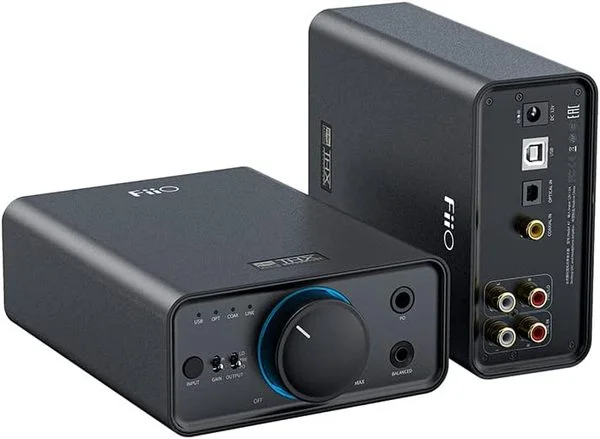
Buy the FiiO K7 if you don’t own a DAC, want a 4.4 mm balanced output, or need optical, coaxial and RCA inputs in one box.
DAC and amp in one box: dual AK4493SEQ, THX AAA 788+ amps, 2 W into 32Ω and 560 mW into 300Ω balanced.
Buy the Schiit Magni (Unity) if you already have a DAC, want the classic Schiit stack, or want the cheapest clean amp for 300Ω headphones.
The Heresy's direct replacement: 2.5 W into 32Ω and 415 mW into 300Ω, three gain settings, $119 or $199 with DAC.
Neither, if you want one box for less: the FiiO K11 R2R (~$170) is FiiO’s newer, cheaper desktop DAC/amp.
Newer and cheaper than the K7, with an R2R DAC and 4.4 mm balanced out. Enough for most headphones.
Not the Fosi K7
“K7” also searches up the Fosi Audio K7, a separate gaming-oriented DAC/amp. Published reviews list an AKM AK4493S DAC, TPA6120 headphone amps, a 4.4 mm balanced output, Bluetooth with aptX HD and aptX LL, and a microphone input with a gaming USB mode. It isn’t related to the FiiO K7, and nothing on this page applies to it.
Specs Comparison
| FiiO K7 | Magni Heresy (discontinued) | Magni (Unity) | |
|---|---|---|---|
| Status | Still sold, off fiio.com | Discontinued | Current |
| Price (Oct 2026) | ~$220 | Used only ($99 at launch) | $119 / $199 with DAC |
| Type | DAC/amp | Amp only | Amp, optional DAC card |
| Power, 32Ω | 2 W bal / ~1.2 W SE | 2.4 W | 2.5 W |
| Power, 300Ω | 560 mW bal | 410 mW | 415 mW |
| Headphone outputs | 6.35 mm + 4.4 mm balanced | 6.35 mm | 6.35 mm |
| Inputs | USB, optical, coaxial, RCA | RCA | RCA (USB-C with DAC card) |
| Line/preamp out | RCA, fixed or variable | RCA preamp | Preamp out |
| Bluetooth | No (K7BT variant only) | No | No |
Power figures are the manufacturers’ published ratings.
Amp Performance
Both the K7 and the Magnis measure well enough that their noise and distortion sit far below audibility at normal levels. Audio Science Review measured the Heresy at a SINAD of about 119 dB in 2019. Owners describe both the K7 and the Magni line as clean and neutral.
The differences that matter are power and connections:
- 300Ω headphones (HD 600/650, DT 990 Pro 250Ω): all three have enough voltage. 410–415 mW into 300Ω is about 11 V RMS; the K7’s balanced 560 mW is about 13 V. See the HD 600 amp guide and HD 650 amp guide .
- Planars (HE400SE, Sundara): all three have enough current. The K7’s balanced output gives the most headroom if your cable is 4.4 mm. See the HE400SE amp guide and Sundara amp guide .
- Sensitive IEMs: the Magni (Unity)’s −10 dB gain setting is a real advantage for low noise and fine volume control.
Connectivity
The K7 is a desk hub: USB for a computer, optical and coaxial for a TV or console, an RCA line input, and a rear RCA output that runs at fixed level for a separate amp or variable level for powered speakers.
The Magni is simpler. As an amp only it takes an RCA source. The $199 version adds a DAC card with a USB-C input, which makes it a two-in-one for a single computer.
The standard K7 has no Bluetooth. FiiO sold a K7BT variant with it.
Total Cost of a Complete Setup
- FiiO K7 alone: about $220. DAC, amp, balanced output, multiple inputs.
- Magni with DAC card: $199. One box, single-ended, USB-C.
- Modi 5 + Magni (Unity): $149 + $119 = $268. Two boxes, more inputs on the Modi, upgradeable separately. See our Modi generations comparison .
Which to Buy
Buy the FiiO K7 if:
- You need a DAC and an amp and want one box
- You use several sources (computer, TV, console)
- Your headphones have, or could have, a 4.4 mm balanced cable
Buy the Magni (Unity) if:
- You already own a DAC
- You want the Schiit stack or the $199 single-box Magni
- You use sensitive IEMs as well as full-size headphones
Looking for the Heresy specifically? Read our Magni Heresy page for what to check on a used one, and the full FiiO K7 review for how the K7 compares with FiiO’s newer K11 R2R and K13 R2R.